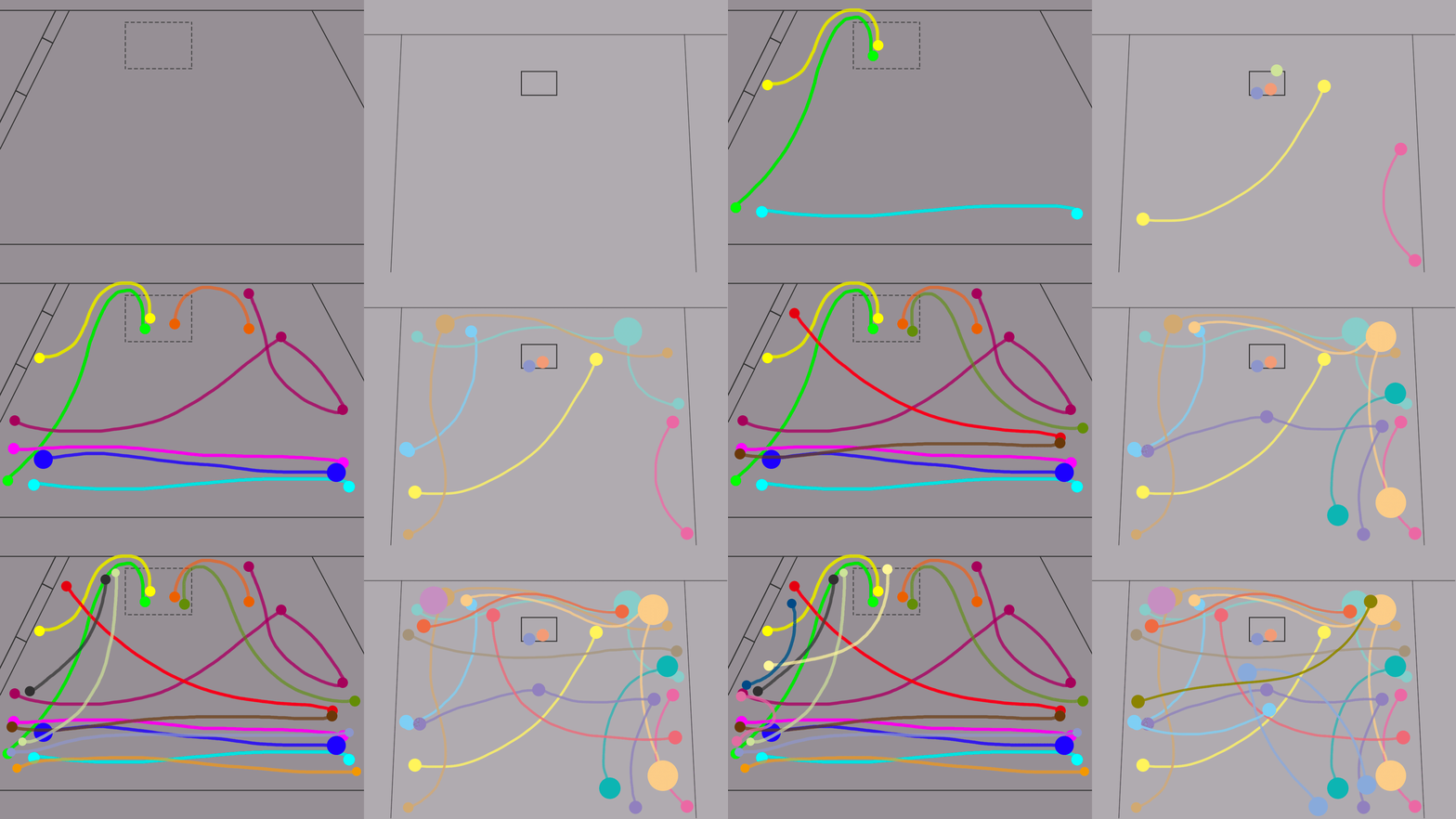
The Personal Space explores how interpersonal distance can be translated from an invisible social convention into a physical experience around the body. The project began during the 2020 lockdown with a small comparative study involving people familiar with both China and the UK. Alongside questionnaires and drawing exercises, I observed visitor movement at Tate Modern in London and the National Art Museum of China, then translated these observations into comparative behaviour maps showing how people occupied, crossed and maintained distance within public space. Together, these studies suggested that participants generally perceived personal space in the UK as larger, looser and more flexible than in China. Rather than treating this as a fixed cultural measurement, I used the contrast as a starting point for exploring how different spatial relationships might be embodied through a wearable form.
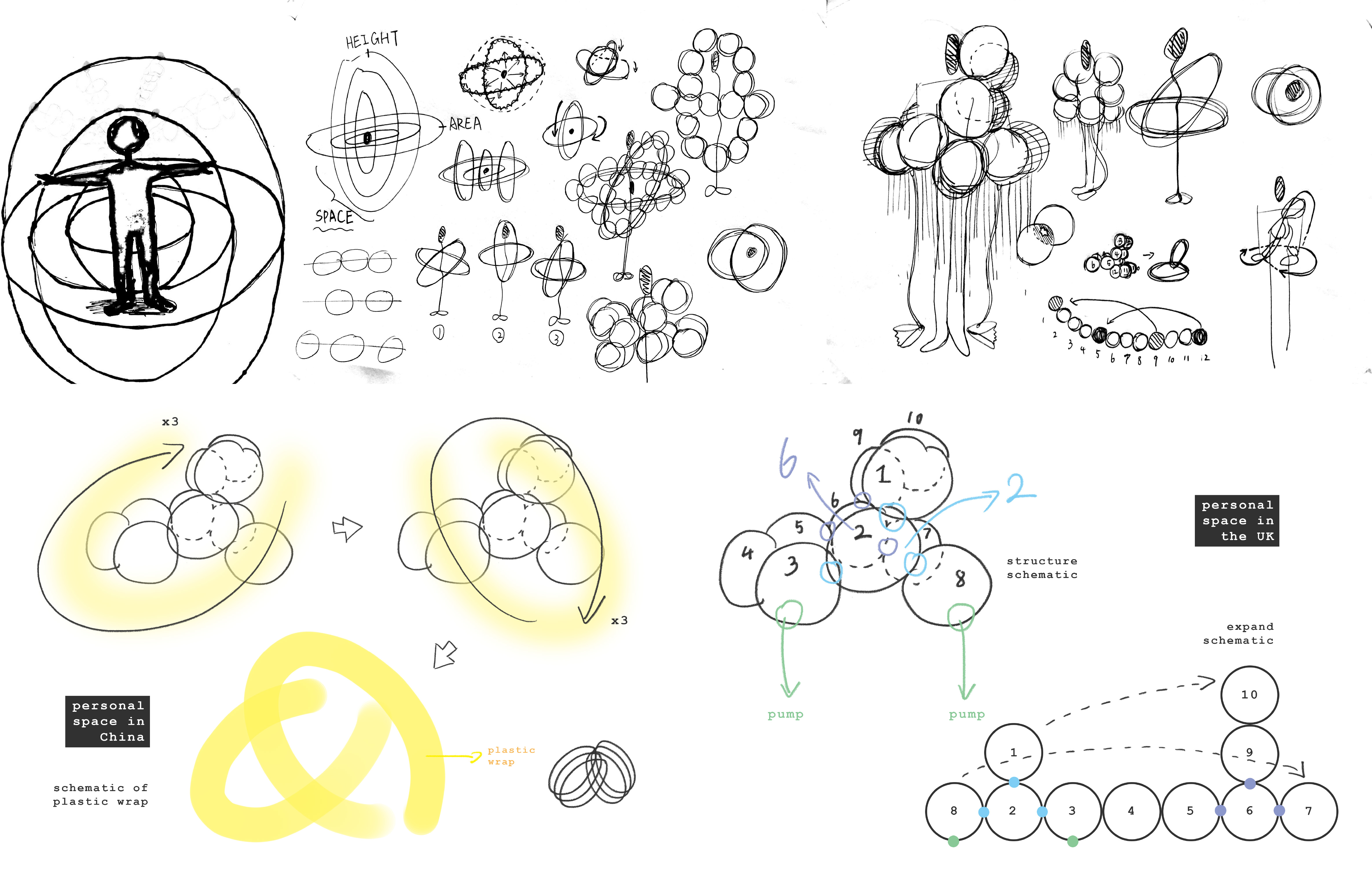
The project shifted from observation into making when I began asking how these invisible spatial relationships might acquire volume. In the drawing exercises, most participants represented personal space as an area surrounding the body, while one response introduced both horizontal area and vertical height. This prompted me to move away from flat diagrams and develop a three-dimensional structure composed of multiple volumes positioned around the wearer. A series of sketches explored their scale, distribution, connection and relationship to the body.
Inflation became the central mechanism because it allowed the boundary around the body to change continuously. I initially experimented with balloons, plastic bags, plastic wrap and different forms of restraint. The material itself became part of the spatial argument: an unrestricted inflatable form could expand away from the body, while wrapping or compressing the same volumes produced a visibly tighter and more restrictive condition.
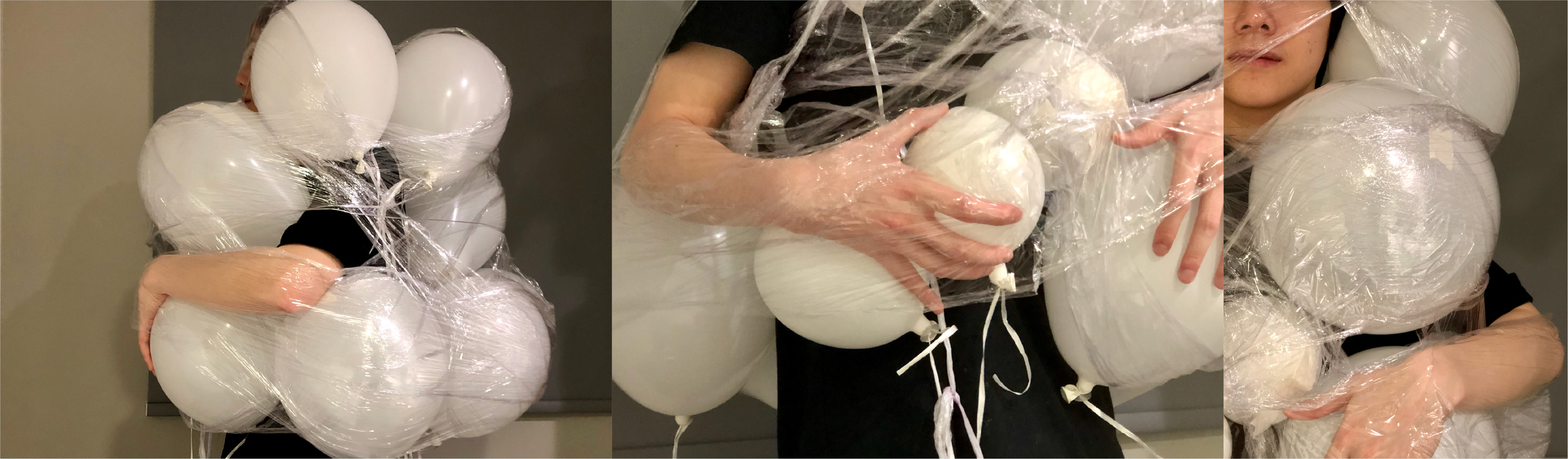
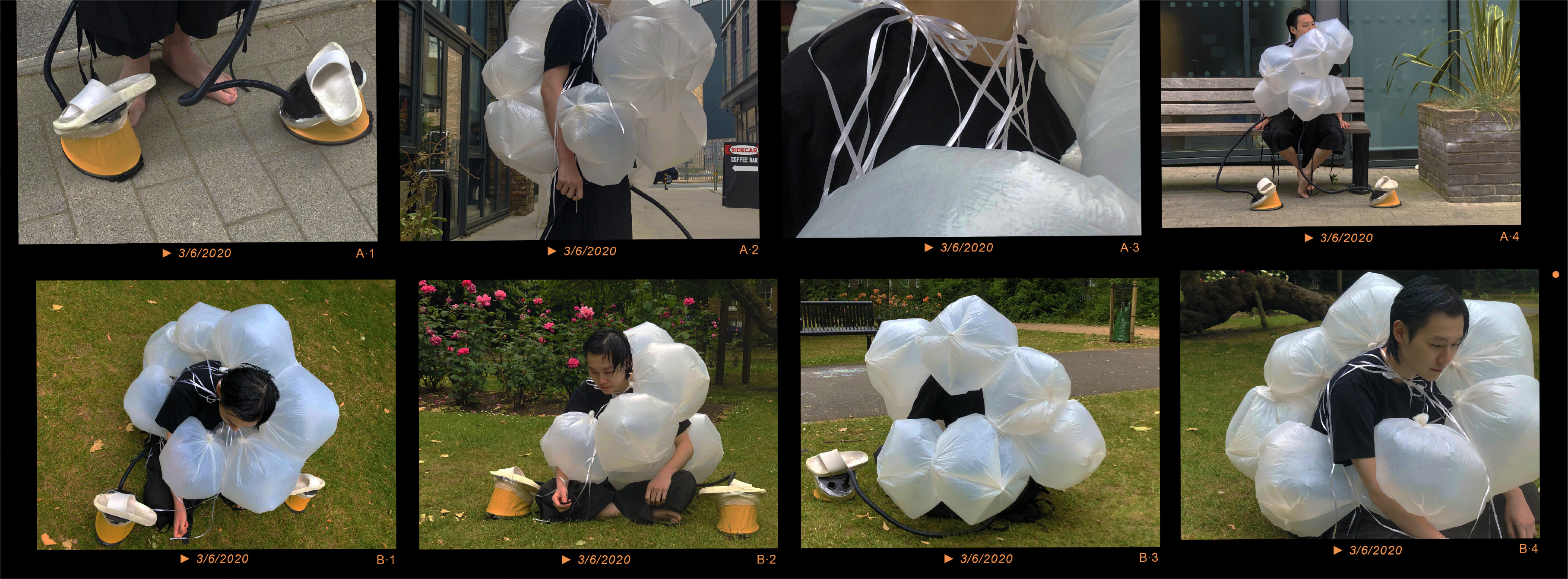
The lockdown strongly shaped the way the project was made. With no access to university workshops, specialist tools or materials, I worked with objects that could be sourced and assembled at home. Repeated tests eventually shifted the project from balloons to plastic bags. Balloons were visually effective but their elasticity made it difficult to inflate several connected chambers evenly. Plastic bags behaved more predictably, allowing air to move progressively through a larger connected structure.
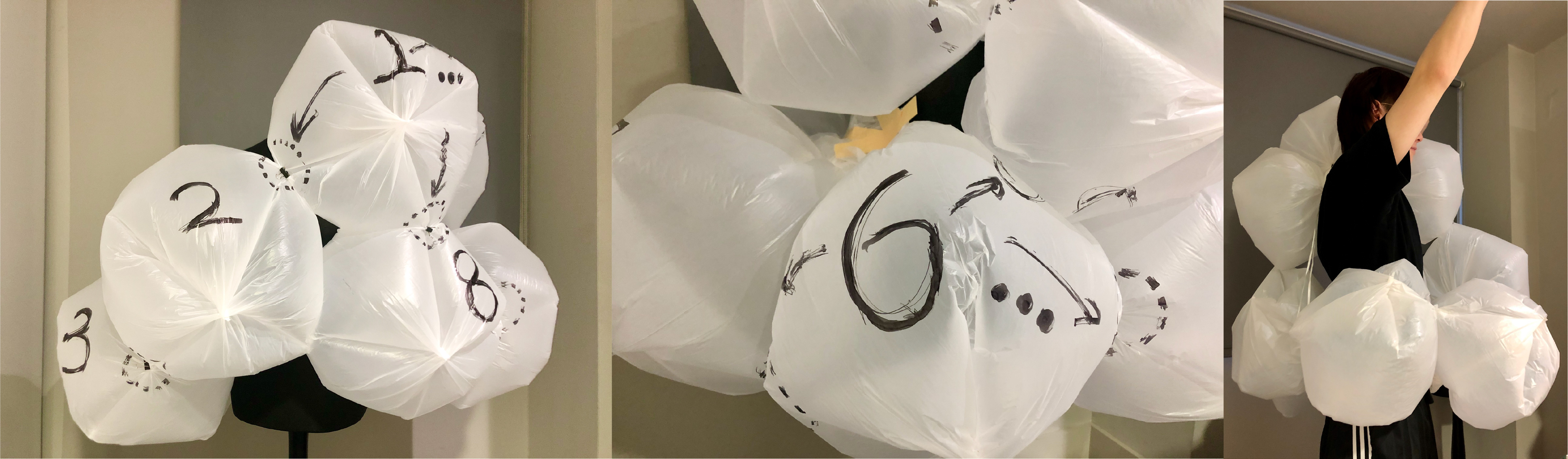
Developing this system required a series of connection experiments around air flow, opening size, sealing and assembly. The final structure used twelve interconnected plastic chambers joined with hot-melt adhesive and tracing-paper connectors. The transparent connector made it easier to align openings on both sides while maintaining an enclosed passage for air. I then connected the wearable to a modified foot-operated pumping system so that inflation could be triggered through the wearer’s own movement rather than by a separate operator.
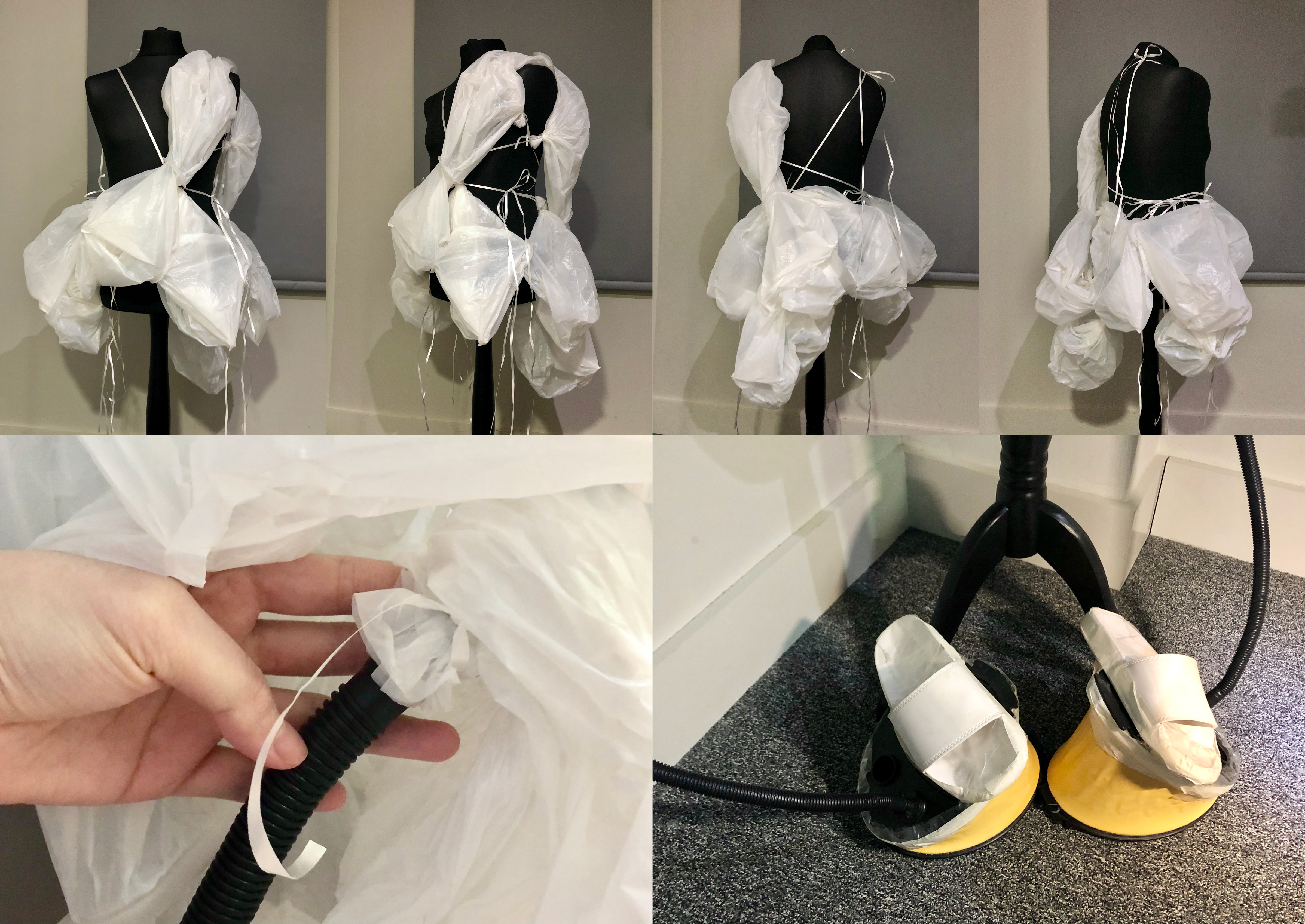
The final wearable translated the earlier comparison into two speculative spatial conditions. One allowed the inflatable chambers to expand freely around the body, while the other introduced transparent wrapping that constrained their expansion and brought the material closer to the wearer. These were not intended as literal models of British and Chinese personal space, but as deliberately exaggerated physical interpretations of the differences reported during the earlier study.
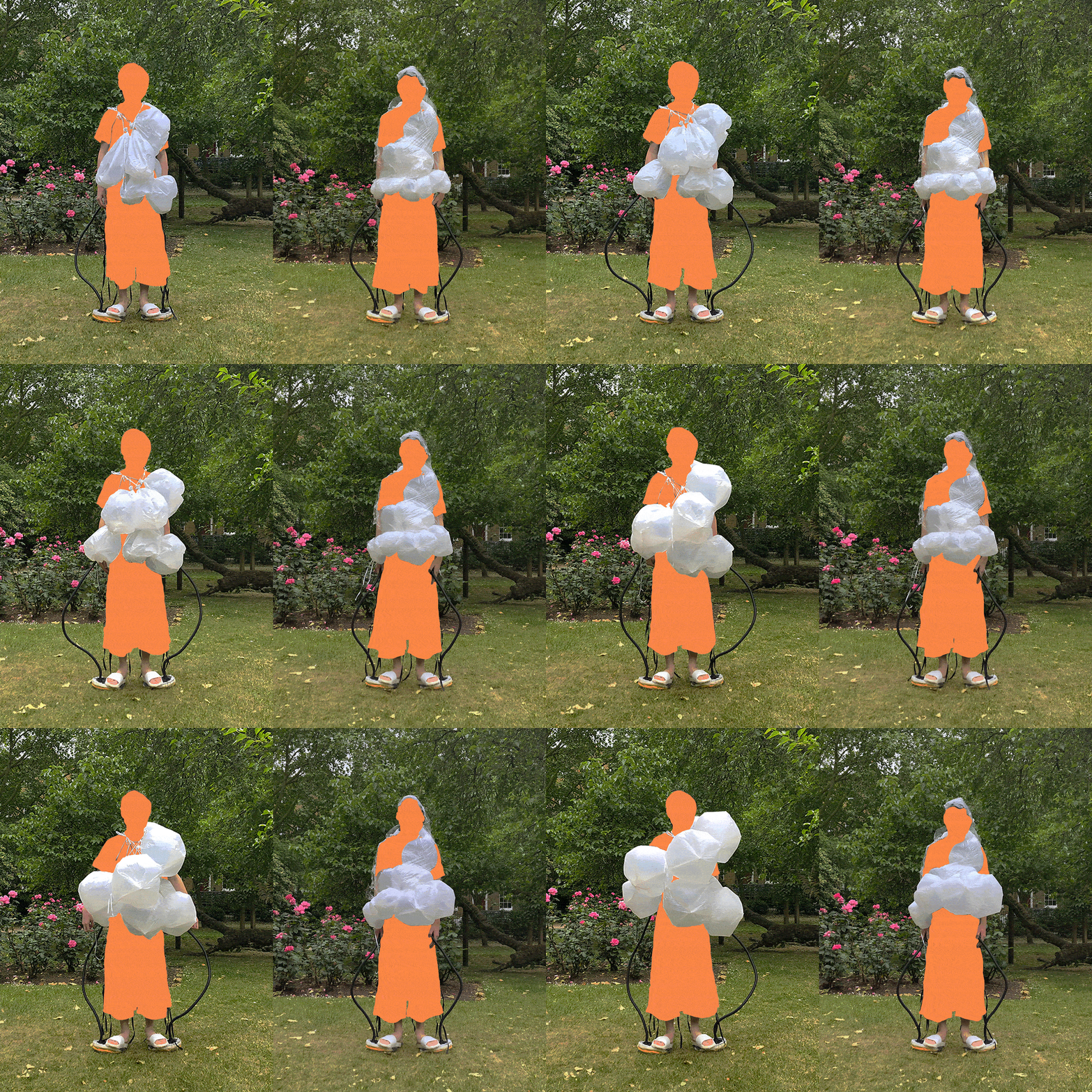
Movement completed the interaction. The wearer operates the pumps while walking, gradually forcing air through the connected chambers and increasing the volume occupied by the wearable. Personal space therefore becomes something performed rather than simply represented: each step physically produces more space around the body. The final outcome turns an abstract relationship between bodies and distance into a temporary, visible and changing spatial structure.
 Marci Chi Ma